| This map is found on Mapicurious.com | Download these points of interest directly into your favorite GPS or other geo software | |||
|
|||
| Use the zoom controls on the map to adjust the map's viewable area then print: | |||

| LOCATIONS highlighted on this map: |
|
lat:33.81143 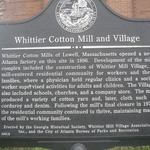
Whittier Cotton Mills of Lowell, Massachusetts opened a new Atlanta factory on this site in 1896. Development of the mill complex included the construction of Whittier Mill Village, a mill-centered residential community for workers and their families, where a physician held regular clinics and a social worker supervised activities for adults and children. The Village also included schools, churches, and a company store. The mill produced a variety of cotton yarn and, later, cloth such as corduroy and denim. Following the mill’s final closure in 1971, the residential community continued to thrive, maintaining many of the mill’s working families.
lat:32.892172 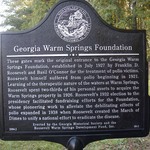
These gates mark the original entrance to the Georgia Warm Springs Foundation, established in July 1927 by Franklin D. Roosevelt and Basil O’Connor for the treatment of polio victims. Roosevelt himself suffered from polio beginning in 1921. Learning of the therapeutic nature of the waters at Warm Springs, Roosevelt spent two-thirds of his personal assets to acquire the Warm Springs property in 1926. Roosevelt’s 1932 election to the presidency facilitated fundraising efforts for the Foundation, whose pioneering work to alleviate the debilitating effects of polio expanded in 1938 when Roosevelt created the March of Dimes to unify a national effort to eradicate the disease.
lat:33.44558 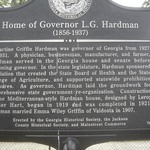
Hugh Manson Dorsey was born in Fayetteville , and was admitted to the Georgia bar at the Fayette County Courthouse in 1894. After practicing law at his father’s firm, Dorsey became solicitor general of the Atlanta Judicial Circuit in 1910. In this capacity, he prosecuted the 1913 murder case against Leo Frank. During his two-term governorship (1917-1921), Dorsey oversaw the wider implementation of the county unit system of election favoring rural areas; appointed Richard R. Wright, Sr. to direct Georgia’s African-American war effort during WWI; and published a pamphlet opposing the unjust treatment of African Americans in Georgia. Hugh Dorsey is buried in Atlanta ’s Westview Cemetery
lat:33.32867 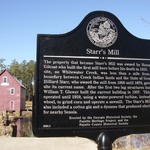
The property that became Starr’s Mill was owned by Hananiah Gilcoat who built the first mill here before his death in 1825. This site, on Whitewater Creek, was less than a mile from the boundary between Creek Indian lands and the State of Georgia. Hilliard Starr, who owned the mill from 1866 until 1879, gave the site its current name. After the first two log structures burned, William T. Glower built the current building in 1907. This mill operated until 1959, using a water-powered turbine, instead of a wheel, to grind corn and operate a sawmill. The Starr’s Mill site also included a cotton gin and a dynamo that produced electricity for nearby Senoia.
lat:33.445436 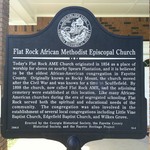
Today's Flat Rock AME Church originated in 1854 as a place of worship for slaves on nearby Spears Plantation, and it is believed to be the oldest African-American congregation in Fayette County . Originally known as Rocky Mount , the church moved after the Civil War and was known for a time as Scufflefield. By 1898 the church, now called Flat Rock AME, and the adjoining cemetery were established at this location. Like many African-American churches during the era of segregated schooling, Flat Rock served both the spiritual and educational needs of the community. The congregation was also involved in the establishment of several local congregations including Little Vine Baptist Church, Edgefield Baptist Church , and Wilkes Grove.
lat:33.359119 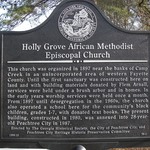
This church was organized in 1897 near the banks of Camp Creek in an unincorporated area of western Fayette County. Until the first sanctuary was constructed here on land and with building materials donated by Flem Arnall, services were held under a brush arbor and in homes. In the early years worship services were held once a month. From 1897 until desegregation in the 1960s, the church also operated a school here for the community's black children, grades 1-7, with donated text books. The present structure, constructed in 1980, was annexed into 28-year-old Peachtree City in 1987.
lat:34.00437 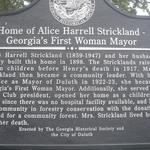
Alice Harrell Strickland (1859-1947) and her husband Henry built this home in 1898. The Stricklands raised seven children before Henry's death in 1917. Mrs. Strickland then became a community leader. With her service as Mayor of Duluth in 1922-23, she became Georgia's First Woman Mayor. Additionally, she served as Civic Club president, opened her home as a children's clinic since there was no hospital facility available, and led the community in forestry conservation with the donation of land for a community forest. Mrs. Strickland lived here until her death.
lat:33.778425 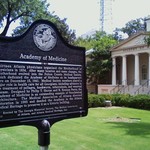
Thirteen Atlanta physicians organized the Brotherhood of Physicians in 1854. After many location and name changes, the Brotherhood evolved in to the Fulton County Medical Society, which dedicated the Academy of Medicine as its headquarters here on December 15, 1941. Medical Society members played a major role in health care for all Georgians, including advances in the treatment of pellagra, hookworm, tuberculosis, and venereal disease. Designed by Philip T. Shutze and R. Kennon Perry, the Academy of Medicine is an outstanding example of Neoclassical architecture. The Medical Association of Atlanta directed restoration in 1983 and deeded the Academy to the Atlanta Medical Heritage to preserve it as an historic building.
lat:33.172474 Settlement of Carmel community began with the creation of Meriwether County in 1827. Early families-- Caldwell, Burton, Campson, Gray, Reynolds, Williams, Pope, and Glass--came from Edgefield District, South Carolina. They established Carmel Academy, churches, a cotton gin, blacksmith shop, general merchandise and farm supply store, millinery, lace business, post office, cane syrup mill, and a pottery. Carmel native, Harmon White Caldwell (1899-1977), became Dean of Lumpkin Law School, President of the University of Georgia, and Chancellor of the University System of Georgia.
lat:33.14296667 In 1886 the county contracted with Washington W. King, son of freed slave and noted bridge builder Horace King, and Jonathan H. Burke for the construction of this 138-foot bridge. It was adjacent to a mill owned by Daniel Lowry, of which the foundation is still evident. This bridge replaced several previous structures, the last having been built two years prior. Constructed in the Town lattice design, the bridge's web of planks crisscrossing at 45-to 60-degree angles are fastened with wooden pegs, or trunnels, at each intersection.
lat:33.774618 The Lutheran Church of the Redeemer was founded in 1903 as the first English-speaking congregation in Atlanta. The church's first building was erected in 1905 near the state capitol. The church moved in 1937 to Peachtree and Fourth Streets where in 1952 its current structure was completed. Designed by Harold Wagoner of Philadelphia, the gothic structure is of Tennessee quartzite and Indiana limestone. Redeemer, founded by thirty-nine people, grew in one hundred years to become the largest Lutheran congregation in Georgia, Alabama, Mississippi and Tennessee, which comprise the Southern Synod of Evangelical Lutheran Church in America.
lat:33.757224 American Missionary Association (A.M.A.) teachers and clergy came to the post-Civil War South to help educate freed slaves. In 1866, missionaries established the Storrs School, located on Houston Street near Piedmont Avenue, to provide social, educational, and religious services for freedmen. Meeting in the Storrs School chapel, freedmen and white missionaries founded First Congregational Church in 1867. This integrated congregation continued to meet in the chapel until 1877 when the A.M.A. donated land on this site. In 1894, Dr. Henry Hugh Proctor became the first African-American pastor of the congregation. This building was constructed in 1908.
lat:33.7716833333333 The Georgia Railway and Power Company, predecessor of Georgia Power, built this trolley waiting station in 1923. The waiting station served Druid Hills residential development when the streetcar line on Ponce de Leon Avenue was extended from downtown to East Lake Drive. The functional design was a common one shared by the electric company’s waiting stations along city streetcar routes. This structure is the power company’s only original waiting station remaining in Atlanta. Buses replaced the streetcars that once stopped here for passengers, and the tracks were removed.
lat:33.236642 Grantville native Thomas E. Zellars (1898-1924) graduated from the U.S. Naval Academy in 1920 and reported for duty aboard the USS Mississippi. As turret commander he rose to the rank of lieutenant. In 1924, an explosion and fire engulfed his turret. Zellars and 47 others were killed but not before he opened a flood valve on a burning powder train - an act that saved the ship and its crew. In 1944, Naval destroyer USS Zellars DD 777 was launched in Zellars' honor. It went on to serve in both WW II and the Korean War receiving five battle stars. The ship was decommissioned in 1971.
lat:32.4579 The first public library for African Americans in segregated Columbus, the Colored/Fourth Avenue Library, opened on January 5, 1953. The existence of this facility resulted from covenants and restrictions barring the use of the city's new public library by African Americans. The project was completed with expenditures of less than one hundred thousand dollars. The library was renamed the Mildred L. Terry Branch in 1981 to honor its first librarian.
lat:33.322026 Allen A. Beall's death in 1861 left his wife, Caroline Davis Beall, with 7 minor children and a 1500-acre corn and cotton plantation. This remarkable woman completed construction of and began operating a grist mill at this site on Crooked Creek in 1862, serving the local community and the Confederate Army while also providing additional income for the family. The mill escaped destruction by Sherman's army in 1864 and continued to serve as an important gathering site for the East Putnam County community until its operation ceased in the early 1900s. Natural forces brought about its physical destruction.
lat:34.2908 Cherokee Chief George Welch constructed a grist mill here on his extensive homeplace c. 1820. An uncovered bridge was later added. With the 1838 removal of the Cherokees, the land was sold to Jacob Scudder. Dr. M. L. Pool purchased it from Scudder's family in 1880. Abandoned in 1947, the mill burned in 1959. The original bridge washed away in 1899 and was replaced with the present 96-foot structure in 1901. Constructed in the Town lattice design by Bud Gentry, the bridge's web of planks crisscrossing at 45-to 60-degree angles are fastened with wooden pegs, or trunnels, at each intersection.
lat:33.034859 This bridge was built in the 1840s by freed slave and noted bridge builder Horace King (1807-1885). Constructed on the Town lattice design, the bridge's web of planks crisscrossing at 45- to 60-degree angles are fastened at each intersection with a total of approximately 2,500 wooden pegs, or trunnels. Although King is credited with the construction of many covered bridges throughout Georgia, this is his only surviving bridge of this design. At 391 feet, including the approaches, this structure is the oldest and longest wooden covered bridge in Georgia.
lat:33.795884 Atlanta philanthropist and businessman Amos Giles Rhodes built Le Rệve (The Dream) on his 114-acre estate in 1904. Designed by Atlanta architect Willis F. Denny II, the house is constructed of Stone Mountain granite and is distinguished by its early use of electricity and stained glass windows depicting the rise and fall of the Confederacy. In 1929, Mr. Rhodes' heirs deeded the house to the State to be used for historical purposes. Renamed "Rhodes Memorial Hall," it operated as the State Archives building until 1965. It became the headquarters of the Georgia Trust in 1983.
lat:33.880195 In 1912 Julius Rosenwald, President of Sears, Roebuck and Company, established the Rosenwald Fund to assist in community school construction of public schools for African-American students in the South. The Julius Rosenwald Fund assisted local communities who raised additional funds. By the 1930s one in every five rural southern schools for blacks had been constructed with aid from the Rosenwald Fund, a total of nearly five thousand schools throughout the South. The Hiram Rosenwald school opened in 1930 as the Hiram Colored School . It was the only Rosenwald school in Paulding County and, at that time, the only African-American school with a library in the county. The school operated from 1930 until 1955. |


|
Although the author has taken all reasonable care in preparing this guide, Mapicurious and the author make no warranty about the accuracy or completeness of its content and accept no responsibility for any loss, injury, or inconvenience arising from its use. |