| This map is found on Mapicurious.com | Download these points of interest directly into your favorite GPS or other geo software | |||
|
|||
| Use the zoom controls on the map to adjust the map's viewable area then print: | |||

| LOCATIONS highlighted on this map: |
|
lat:34.09737 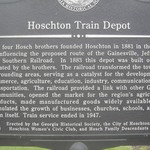
The four Hosch brothers founded Hoschton in 1881 in the hope of influencing the proposed route of the Gainesville, Jefferson and Southern Railroad. In 1833 this depot was built on land donated by the brothers. The railroad transformed the town and surrounding areas, serving as a catalyst for the development of commerce, agriculture, education, industry, communications, and transportation. The railroad provided a link with other Georgia communities, opened the market for the region's agricultural products, made manufactured goods widely available, and stimulated the growth of businesses, churches, schools, and the town itself. Train service ended in 1947.
lat:34.27492 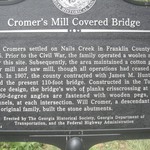
The Cromers settled on Nails Creek in Franklin County in 1845. Prior to the Civil War, the family operated a woolen mill near this site. Subsequently, the area maintained a cotton gin, flour mill and saw mill, though all operations had ceased by 1943. In 1907, the county contracted with James M. Hunt to build the present 110-foot bridge. Constructed in the Town lattice design, the bridge's web of planks crisscrossing at 45-to 60-degree angles are fastened with wooden pegs, or trunnels, at each intersection. Will Cromer, a descendant of the original family, built the stone abutments.
lat:34.20153 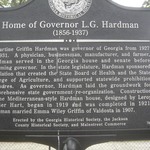
Lamartine Griffin Hardman was governor of Georgia from 1927 to 1931. A physician, businessman, manufacturer, and farmer, Hardman served the the Georgia house and senate before becoming governor. In the state legislature, Hardman sponsored legislation that created the Sate Board of Health and the State College of Agriculture, and supported statewide prohibition measures. As governor, Hardman laid the groundwork for comprehensive state government re-organization. Construction on the Mediterranean-style Hardman house, designed by Leroy Collier Hart, began in 1919 and was completed in 1921. Hardman married Emma Wiley Griffin of Valdosta in 1907.
lat:34.43512 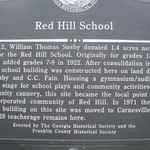
In 1912, William Thomas Sosby donated 1.4 acres near this site for the Red Hill School. Originally for grades 1-6, the school added grades 7-9 in 1922. After consolidation in 1925, a new school building was constructed here on land donated by Sosby and C.C. Fain. Housing a gymnasium/auditorium with a stage for school plays and community activities and a community cannery, this site became the focal point of the unincorporated community of Red Hill. In 1971 a third school building was moved to Carnesville. Only the 1928 teacherage remains here.
lat:34.34720 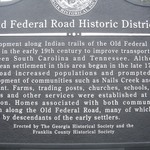
Development along Indian trails of the Old Federal Road began in the early 19th century to improve transportation between South Carolina and Tennessee. Although European settlement in this area began in the late 1700s, the road increased populations and prompted the development of communities such as Nails Creek and Mt. Pleasant. Farms, trading posts, churches, schools, post offices and other services were established at each location. Homes associated with both communities remain along the Old Federal Road, many of which are owned by descendants of the early settlers.
lat:34.10673 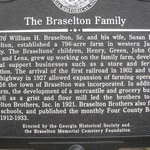
In 1876 William H. Braselton, Sr. and his wife, Susan Hosch Braselton, established a 796-acre farm in western Jackson County . The Braseltons' children, Henry, Green, John Oliver, Belle, and Lena , grew up working on the family farm, developing several support businesses such as a store and fertilizer operation. The arrival of first the railroad in 1902 and then a state highway in 1927 allowed expansion of farming operations. In 1916 the town of Braselton was incorporated. In addition to the farm, the development of a mercantile and grocery business as well as a grist and flour mill led the brothers to form Braselton Brothers, Inc. in 1921. Braselton Brothers also funded local schools, and published the monthly Four County Booster from 1912-1933.
lat:33.97655 In 1785, following the Revolutionary War, pioneers from North Carolina--including the Hendons, Hartsfields, Standifers, Johnsons, Lawrences, and Olives--settled near Big Cloud's Creek on the Georgia frontier near the Creek and Cherokee nations. Olive's Fort was soon constructed and Cloud's Creek Baptist Church was constituted within its walls in 1788. The church was later moved 2.5 miles south to its present location on land deeded by Thomas Hendon in 1798. The second and current sanctuary on the new site was constructed in 1909, and continues in use today.
lat:30.845961 In 1916 five prominent Valdosta businessmen and civic leaders--William S. West, Lowndes W. Shaw, Leonard F. Shaw, Daniel C. Ashley, and Owen K. Jones--donated 11 acres to the city to create a public park. The deed stipulated that the property could only be used as a park. A section was set aside in 1925 for construction of the Woman's Building, still an important social and civic center for women's organizations and activities. Originally named Brookwood Park, the land was renamed in 1979 for Richard J. Drexel, a landscape architect who served from 1925 to 1959 as the city's first Superintendent of Parks. Located at the corner of N. Patterson and Brookwood Streets in Valdosta.
lat:33.8027666666667 Built in 1897 by Nathaniel Richardson, this 99-foot-long bridge originally carried the Watkinsville-Athens Road over Calls Creek. It was moved here to Rose Creek in 1924 and the road was relocated to its present site. The nearby c. 1900 grist mill ceased operations in 1941. Constructed in the Town lattice design, the bridge's web of planks crisscrossing at 45- to 60-degree angles are fastened with wooden pegs, or trunnels, at each intersection. It is one of the few covered bridges in Georgia continuing to carry traffic without underlying steel beams.
lat:33.98643333 Built in 1904-05 to replace an earlier structure, this bridge bears the name of a pioneer family who settled near Big Cloud's Creek in the late 1700s. Constructed in the Town lattice design using convict labor, the 164-foot bridge's web of planks crisscrosses at 45-to 60-degree angles and are fastened with wooden pegs, or trunnels, at each intersection. The south Georgia timber used in the bridge was transported to Smithonia via the Smith and Dunlap Railroad, a standard gauge steam railroad connecting the farm complex of James Monroe Smith with the Georgia Railroad at Dunlap.
lat:33.95035 This academy was founded in 1881 at Landrum Chapel (Ebenezer Baptist Church, West) by the Rev. Collins Henry Lyons. In 1886 a new facility was constructed at this site, now on the University of Georgia campus. Here black youth were taught college preparatory courses in English, Greek, Latin, French, history, mathematics, public speaking, agriculture, sewing, cooking, music and printing. In 1924 the school consolidated with three other institutions to become Union Baptist Institute. The institute was dissolved and the building demolished in 1956 following desegregation and consolidation of the local public school system.
lat:33.9606 Originally from Macon , Georgia , African-American architect Louis H. Persley attended Lincoln University, and graduated from Carnegie Institute of Technology in 1914. Persley then joined the faculty of the Tuskegee Institute in Alabama . One of his few projects in Georgia, Persley designed a new building for the First African Methodist Episcopal Church on this site in 1916. First AME began as Pierce's Chapel in 1866, believed to be the first congregation in Athens established by African Americans after the Civil War. Persley went on to design buildings including the Masonic Temple in Birmingham , and several structures on the campus of Tuskegee . On April 5, 1920 Louis Persley became the first African American to register with the new Georgia State Board of Registered Architects.
lat:34.1562333333333 On the night of July 11, 1964 three African-American World War II veterans returning home following training at Ft. Benning , Georgia were noticed in Athens by local members of the Ku Klux Klan. The officers were followed to the nearby Broad River Bridge where their pursuers fired into the vehicle, killing Lt. Col. Lemuel Penn. When a local jury failed to convict the suspects of murder, the federal government successfully prosecuted the men for violations under the new Civil Rights Act of 1964, passed just nine days before Penn's murder. The case was instrumental in the creation of a Justice Department task force whose work culminated in the Civil Rights Act of 1968.
lat:33.8571 2.4 miles east, at Moore's Ford Bridge on the Apalachee River, four African-Americans - George and Mae Murray Dorsey and Roger and Dorothy Dorsey Malcom (reportedly 7 months pregnant) - were brutally beaten and shot by an unmasked mob on the afternoon of July 25, 1946. The lynching followed an argument between Roger Malcom and a local white farmer. These unsolved murders played a crucial role in both President Truman's commitment to civil rights legislation and the ensuing modern civil rights movement. In 1998, a biracial memorial service honoring the victims was held at Moore's Ford Bridge.
lat:33.5955666666667 Oliver Norvell Hardy, of the comedy team Laurel and Hardy, lived in the Turnell-Butler Hotel which once stood on this corner. He was born in Harlem, Georgia, on January 18, 1892. The family was in Madison by that February, and may have moved here earlier. Mrs. Hardy later opened a hotel in Madison named The Hardy House. Oliver began his education at age six at the Madison Grammar School. Mrs. Hardy and her children left Madison in October 1898. Oliver Hardy died in 1957 and is buried in California where a plaque reads: "His Talent Brought Joy and Laughter To All The World."
lat:31.480245 Wesley Raymond, Robert Richardson and others founded a school here in 1939 to teach basic flight skills to college students. With the start of World War II, the school became the 63rd Flight Training Detachment Airbase and provided primary flight training for several thousand young men. In addition to working clerical and food preparation jobs, many local women served as civilian base dispatchers and aircraft mechanics. Although officially closed in 1944, the airstrip and hangers have continued in use as a municipal airport and the barracks and administration buildings have seen a wide variety of community uses.
lat:31.540021 This church was organized in 1857. The first sanctuary, made of logs, was situated near the still-present old well. A number of Coffee County's prominent citizens were early members of the church and are buried within the cemetery, including William Dent, Daniel Gaskins, Sr., Franklin Ward and Thomas H. Dent. In 1875, the church became the founding location of the Smyrna Baptist Association, currently comprised of thirty-nine churches. The existing sanctuary was constructed c.1905. The Sunday School rooms were moved on site and attached to the sanctuary in 1954.
lat:33.95366667 Between 1942 and 1945, the Navy operated a Pre-Flight School on the University of Georgia campus. As one of only five such schools in the nation, the program trained approximately 20,000 cadets in the skills needed as combat pilots in the Pacific theater of World War II. The Navy utilized most of the existing campus and built numerous buildings and athletic facilities used by the college in later years. Additional Athens-area sites were also utilized and improvements were made to local streets and Ben Epps Airport. Few physical reminders of this large Naval presence remain.
lat:33.47215 White Plains Baptist Church was organized in 1806, with all four sanctuaries located here. The current sanctuary was constructed in 1887. Welcoming its first African-American member in 1812, both races worshipped together until 1869. In the late 1820s the church was instrumental in the founding of Siloam Baptist Church, formerly a branch of this church. To date only 20 pastors have served here. James H. Kilpatrick, pastor from 1854 to 1908, also served as moderator of the Georgia Baptist Association for 23 years and as President of the Georgia Baptist Convention for 6 years. |


|
Although the author has taken all reasonable care in preparing this guide, Mapicurious and the author make no warranty about the accuracy or completeness of its content and accept no responsibility for any loss, injury, or inconvenience arising from its use. |