| This map is found on Mapicurious.com | Download these points of interest directly into your favorite GPS or other geo software | |||
|
|||
| Use the zoom controls on the map to adjust the map's viewable area then print: | |||

| LOCATIONS highlighted on this map: |
|
lat:32.040677 Built by Federal troops during the Civil War, in February 1862, Battery Hamilton prevented Confederate gunboats and reinforcements from moving down the Savannah River to aid the besieged Fort Pulaski. Its presence also allowed the Federals to construct the eleven artillery batteries that pounded Fort Pulaski into surrender in April 1862. Battery Hamilton was constructed and occupied by Company E and a detachment from Company A of the Third Rhode Island Heavy Artillery. The armament consisted of six heavy, rifled cannons. Battery Hamilton was abandoned after Fort Pulaski fell to Federal troops.
lat:32.059916 This was the site of the first hospital in Savannah to train African-American doctors and nurses. Named for Doctors Cornelius and Alice McKane, it began on June 1, 1896, when a small group of African Americans received a charter to operate the McKane Hospital for Women and Children and Training School for Nurses. The original hospital was a five-room wooden building. Charity Hospital completed this brick structure in 1931 and continued here until 1964. The building was used as a nursing home until 1976 and was rehabilitated for housing in 2002.
lat:32.079623 This Episcopal Church was the first house of worship established with the founding of Georgia in 1733. Early rectors included the Rev. John Wesley (1736-37), who began the earliest form of Sunday school and published the first English hymnal in the colonies, and the Rev. George Whitefield (1738-40), founder of Bethesda Orphanage. The cornerstone for the first building on this site was laid in 1744. James Hamilton Couper designed the current and third structure in 1838. The 1819 Revere & Son bell continues in use today. One of many prominent members was Juliette Gordon Low, founder of the Girl Scouts of America. Located in Johnson Square in downtown Savannah.
lat:32.076019 First Baptist Church, Savannah's oldest standing house of worship, was designed by Elias Carter and completed in 1833. The congregation dates to 1800. In 1922 the front of the building was extended, and cupola removed, and the edifice covered with limestone. Under the leadership of Sylvanus Landrum, First Baptist Church was one of the few southern churches to remain open throughout the Civil War. Notable pastors include W.L. Pickard, later president of Mercer University; Norman Cox, executive secretary of the Historical Commission of the Southern Baptist Convention; and Arthur Jackson, executive secretary of the Georgia Baptist Foundation.
lat:32.060907 Florance Street School was designed by the firm Levy and Clarke and built in 1929 as one of the early public schools in Savannah built specifically for African-American students. It contributed greatly to Savannah’s Cuyler-Brownville community by offering quality education and leadership development to its students. The school’s construction was a direct result of efforts by Savannah’s African-American community in 1928 to remedy inequities in segregated schools. These efforts brought about a three-hundred-percent increase in state expenditures for black schools. Florence Street School was desegregated in 1971, along with Savannah’s other public schools, and it continued to serve as an elementary school until 1987. The building was rehabilitated as housing in 2000.
lat:32.06835 In the 1840s, William Brown Hodgson (1801-1871) conceived the idea of setting aside ten acres of wooded land at this site for development of Savannah's first recreational park. It was named for former Georgia Governor John Forsyth (1780-1841). William Bischoff created the original landscape design. In the early 1850s improvements to the park included removal of some pines for walkways and ornamental plantings, benches, and iron fencing around the perimeter. In 1854 the fountain and radiating walks were added. Originally created as a military parade ground, the twenty-one-acre Park Extension was added in 1867. The dummy forts were built in c.1909 and used for training during World War I.
lat:32.05785 Chartered by the Georgia General Assembly in 1832, the Infirmary was established “for the relief and protection of afflicted and aged Africans” under the provisions of the last will and testament of Savannah merchant and minister Thomas F. Williams (1774-1816). Originally located south of the city, it was moved here in 1838. Its fourteen acres included several single-story buildings and small farm tracts for vegetable gardens. In 1904, the Infirmary became one of the earliest training schools for African-American nurses. In 1975, it became Georgia’s first day center for stroke rehabilitation.
lat:32.226039 Houston Baptist Church and its adjoining cemetery were organized in 1886 under the leadership of Reverend Ulysses L. Houston, minister of First Bryan Baptist Church in Savannah. A significant religious and political leader in the African-American community, Houston attended the meeting at Gen. Sherman’s Savannah headquarters in January 1865 that resulted in Special Field Order No.15 (the redistribution of confiscated coastal land in forty-acre tracts to newly freed blacks). Houston also served a term in Georgia’s Reconstruction legislature. Established in the tradition of earlier plantation praise houses intended to Christianize the enslaved populations of rural plantations, Houston Baptist Church served the African Americans of Rice Hope Plantation. Houston Baptist Church continued to serve the local community until the 1970s.
lat:32.07975 Jane Cuyler (born Jeanne de la Touche) came to Savannah with her husband Teleman in 1768. After his death in 1772, Cuyler took in lodgers, first at her home on the corner of Bull and Broughton Streets, then at an undetermined location on Bay Street. It was at her home on Bay Street that she hosted meetings of Savannah’s Liberty Boys, among them her son Henry Cuyler. After the capture of Savannah by the British, Jane Cuyler’s role in supporting the efforts of the revolutionaries resulted in an arrest warrant issued by Governor Wright in January 1781. By that time, however, Cuyler had followed the advice of friends and fled Savannah.
lat:32.0814 Joel Chandler Harris (1845-1908), New South journalist and author of Uncle Remus tales, Free Joe, and many other works, was associate editor of the Savannah Morning News from 1870 until 1876, under William Tappan Thompson, an established writer of southern humor. He published comic stories in his Affairs of Georgia column, which was often reprinted around the state. Rooming at the Florida House, which merged in 1880 with the Marshall House on East Broughton Street, Harris married Esther LaRose in 1873. The couple and their two children left Savannah in 1876 to avoid the yellow fever epidemic. Harris served from 1876 until 1900 as associate editor of the Atlanta Constitution.
lat:32.066733 World-renowned songwriter John Herndon Mercer was born in Savannah and spent much of his youth in this house at 226 East Gwinnett Street. His lyrics reflected the sounds of Southern conversation, influenced by the African-American music and the natural world he experienced. During his career Mercer wrote more than one thousand songs, and nearly four hundred were used in motion pictures. Of these, eighteen were nominated for Academy Awards® four of which ("On the Atchison, Topeka and the Santa Fe," "In the Cool, Cool, Cool of the Evening," " Moon River," and "Days of Wine and Roses") won Best Song. Mercer was a co-founder of Capitol Records and the founding president of the Songwriters Hall of Fame. Johnny Mercer is buried in Savannah's Bonaventure Cemetery .
lat:32.059846 In 1853, the city reserved 4 acres in the new Laurel Grove Cemetery for Savannah's African American community. This new burial ground replaced an older black cemetery located near Whitefield Square. Pastors Andrew Bryan (First Colored Baptist Church) and Henry Cunningham (Second Baptist Church) were among those whose bodies were moved to the new location. Here are buried many of Savannah's prominent black leaders--educators, civic/community leaders, Masons, politicians, entrepreneurs, and religious leaders. Later increased in acreage by the city, it continues in use today.
lat:32.0624166666667 This building was constructed in 1897-98 as a memorial to General Alexander R. Lawton (1818-96) and his daughter, Corinne (1844-77). It was used as a public space for cultural, educational and civic purposes until the 1930s. After serving in the Georgia House of Representatives and as president of Georgia and Atlantic Railroad, Lawton served as Brigadier General and Quartermaster-General of the Confederacy, as ambassador to Austria- Hungary, and as fifth president of the American Bar Association. Chartered in 1907, St. Paul’s Greek Orthodox Church acquired the building as its Sanctuary in 1941.
lat:32.066062 A pioneer in women’s education, Nina Anderson Pape completed her studies at Columbia University. She founded the Froebel Circle, which educated the poor children of Savannah’s Yamacraw Village; and Tybee Island’s Fresh Air Home for disadvantaged youth. At this location in 1905, she established the Pape School, which became one of the premier schools for girls in the Southeast. Miss Pape was instrumental in bringing kindergartens to Georgia and included one in her school’s curriculum in 1911. Students from the Pape School in 1912 comprised the first two Girl Scout troops in America. Miss Pape became a leading advocate of higher education for women. The Pape School became Savannah Country Day School in 1955.
lat:31.989824 Established by African Americans in the nineteenth century, Sandfly is centered around the intersection of Mongomery Crossroad and Skidaway road. Many families in this community trace their ancestry to former slaves from nearby Wormsloe Plantation, bought land as free persons, and established homes and churches. After 1870 Central Avenue became the main route for the Industrial Streetcar System, making Sandfly a crossroads between the city of Savannah and Wormsloe Plantation, Bethesda Home for Boys, Isle of Hope, and Pinpoint. Sandfly continues to thrive as a historic African-American community.
lat:32.08095 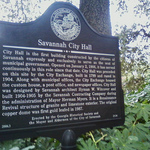
City Hall is the first building constructed by the citizens of Savannah expressly and exclusively to serve as the seat of municipal government. Opened on January 2, 1906, it has served continuously in this role since that date. City Hall was preceded on this site by the City Exchange, built in 1799 and razed in 1904. Along with municipal offices, the City Exchange housed the custom house, a post office, and newspaper offices. City Hall was designed by Savannah architect Hyman W. Witcover and built 1904-1905 by the Savannah Contracting Company during the administration of Mayor Herman Myers. It is a Renaissance Revival structure of granite and limestone exterior. The original copper dome was first gold leafed in 1987.
lat:32.0466166666667 Savannah High School evolved as the senior division of Chatham Academy, chartered by the Georgia Legislature in 1788. In 1935, due to overcrowding in schools, the Board of Education collaborated with the Public Works Administration to erect this structure, the largest construction in the state at that time. In 1963 twelve African-American students selected by the NAACP integrated Savannah High School, one of the first two schools in Chatham County to integrate. Savannah High School moved to Pennsylvania Avenue in 1997 and Savannah Arts Academy, a visual and performing arts school, occupied this site.
lat:32.022405 Chartered in 1842, the Savannah-Ogeechee Canal was constructed between 1826 and 1830 by African and Irish laborers who moved thousands of cubic yards of earth. A boon to Georgia's economy, the canal moved cotton, rice, bricks, and natural fertilizer. The lumber industry revived canal usage following a Civil War-era lull, but a yellow fever epidemic blamed on the canal caused a further decline. the canal closed in the early 1890's as the Central of Georgia Railroad served transportation needs. Beginning at the Savannah River, the canal comprises six locks and 16.5 miles, ending at the Ogeechee River.
lat:32.0797666666667 Once known as the Strand and later as "Irish Green" because of its proximity to the Irish residents of Savannah's Old Fort neighborhood, this park was renamed in 1902 for the Irish patriot Robert Emmet (1778-1803) to commemorate the centennial of his death. Emmet, who led an unsuccessful Dublin uprising for Irish independence and was executed for treason, was a hero to Savannah's Irish community. Emmet is best known for the speech in which he asked that his epitaph not be written until "my country takes her place among the nations of the earth." Emmet Park remains an important center of ceremonial congregation for Savannahians of Irish descent.
lat:32.081756 The colony of Georgia began on Savannah's waterfront in 1733. The riverfront has always played an important role in Georgia, whether as colonial port, exporter of cotton, or tourist destination. The first commercial house below the bluff opened in 1744. Cotton dominated Savannah's exports throughout the nineteenth century. Construction began in the early 1800s for the multi-storied warehouses and "Factor's Walk," named for the cotton brokers whose offices were in the upper floors. River Street was created in 1834 and cobbled with ballast stones. The last cotton office on the waterfront closed in 1956. River Street's revitalization began in 1977. Located on River Street behind City Hall in downtown Savannah.
lat:32.053658 Beginning on December 10, 1864, Union and Confederate soldiers fought near here at Shaw’s Bridge and Shaw’s Dam, as Union General William T. Sherman’s army moved toward Savannah. During bloody fighting, Confederates twice repulsed Union attempts to overwhelm the Confederate earthworks covering the causeway across the Savannah-Ogeechee Canal. On December 20, 1864, after the fall of Fort McAllister due south of here, the Confederates abandoned their defensive positions and retreated into the city, setting the stage for the surrender of Savannah two days later and marking the end of Sherman’s March to the Sea.
lat:32.027949 In her will, Mary Telfair (1791-1875) provided for the establishment of a women’s hospital and also named the first president (Louise Gilmer) and six directresses to manage it. Originally located at the southwest corner of Drayton and New Houston (now Park Avenue) Streets, the Telfair Hospital for Females opened in 1886 as the first hospital in Georgia dedicated exclusively to the care of women. The hospital opened a children’s ward in 1896 and started one of the state’s first nursing schools in 1900. After years of financial struggles, the directresses finalized a merger with Candler Hospital on January 1, 1960. In 1980 a new facility was built at this location and the original Telfair building was sold.
lat:32.068894 The McKelvey-Powell Building was originally constructed in 1926. The building was a hub of African-American business and social life in Savannah during the era of segregation in the first half of the twentieth century. Throughout the 1930s the McKelvey-Powell Building was a popular venue for both local music talent and nationally recognized performers. During World War II the building housed a USO center for black soldiers. Afterward, the West Broad Street YMCA operated in the building until the 1960s. It was later renovated, and dedicated in August 2003 as a community resource center under the guidance of Pastor Bennie R. Mitchell, Jr. and the Connor's Temple Baptist Church congregation.
lat:32.022868 This is the oldest remaining building on the Savannah State University campus. It was constructed in 1901 by the students and faculty of then Georgia State Industrial College during the administration of the college’s first president, Richard R. Wright, Sr. It is named for the chancellor of the University of Georgia at that time. President William Howard Taft visited Hill Hall in 1912 and African American soldiers trained here during World War I. The building has served as a dormitory, library, classroom and administrative building, student center, book store, and post office.
lat:32.179971 Near here stood Mulberry Grove, plantation home of General Nathanael Greene and Catherine Littlefield Greene. President George Washington twice visited the widowed Mrs. Greene at Mulberry Grove during his Southern tour of 1791. Traveling downriver from Purrysburg, South Carolina to Savannah on Thursday, May 12, Washington, "called upon Mrs. Greene & asked her how she did." Three days later, en route overland from Savannah to Augusta, the President "dined at Mulberry Grove" before traveling on to lodge at "one Spencers" fifteen miles north in Effingham County. After traveling through modern-day Screven and Burke counties, Washington reached Augusta on Wednesday, May 18. |


|
Although the author has taken all reasonable care in preparing this guide, Mapicurious and the author make no warranty about the accuracy or completeness of its content and accept no responsibility for any loss, injury, or inconvenience arising from its use. |