| This map is found on Mapicurious.com | Download these points of interest directly into your favorite GPS or other geo software | |||
|
|||
| Use the zoom controls on the map to adjust the map's viewable area then print: | |||

| LOCATIONS highlighted on this map: |
|
lat:37.424637 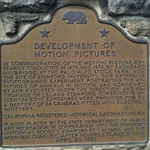
In commemoration of the motion picture research conducted in 1878 and 1879, by Eadweard Muybridge, at the Palo Alto Stock Farm, now the site of Stanford University. This extensive photographic experiment portraying the attitudes of animals in motion was conceived by and executed under the direction and patronage of Leland Stanford. Consecutive instantaneous exposures were provided for by a battery of 24 cameras fitted with electro-shutters. California Registered Historical Landmark No. 834 Plaque placed by the State Department of Parks and Recreation in cooperation with the Stanford Historical Society, Stanford ECV Alumni, and the Mountain Charlie Chapter No. 1850, E Clampus Vitus, April 30, 1983.
lat:36.729113 
Ranks among the most famous quicksilver mines of the world. Named for Idria Mine, then in Austria. Mission fathers, before American occupation, made assays and determined ore to be cinnabar. Work begun in 50's. In 1881 between two and three hundred men were employed. Historical Landmark No. 324 Department of Public Works - Division of Highways
lat:37.263012 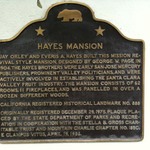
Jay Orley and Everis A. Hayes built this Mission Revival style mansion, designed by George W. Page in 1904. The Hayes brothers were early San Jose Mercury publishers, prominent Valley politicians, and were actively involved in establishing the Santa Clara Valley fruit industry. The mansion consists of 62 rooms, 11 fireplaces, and was paneled in over a dozen different woods. California Registered Historical Landmark No. 888 Originally registered December 29, 1975. Plaque placed by the State Department of Parks and Recreation in cooperation with the Stella B. Gross Charitable Trust and Mountain Charlie Chapter No. 1850, E. Clampus Vitus, April 19, 1986.
298 Pacific St San Francisco , CA
lat:37.7977641 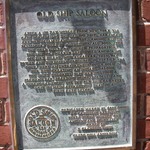
After a 178 day voyage from New York via Cape Horn in 1849 the sailing ship "Arkansas" arrived in San Francisco Bay. Among her 112 passengers were 76 Methodists, all bound for the gold fields or church propagation. The ship was nearly lost while anchoring off Bird Island, now Alcatraz, then was towed and purposely grounded in Yerba Buena Cove. Here an entrepreneur cut a hole in her bow creating an instant saloon. The ship's colorful past has included a seaman's bar, boarding house, bordello and a "Shanghai-shop", yet the old ship has never lost its main attraction, that of a first rate saloon. Dedicated March 23, 6007 (2002) by Capitulus Redivivus Yerba Buena Number One Ancient and Honorable Order of E Clampsus Vitus Credo Quia Absurdum
lat:37.80028 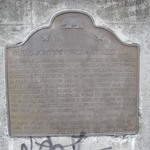
lat:37.080372 California Registered Historical Marker No. 829
lat:35.02773 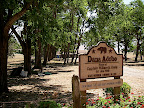
Home of Captain William G. Dana. Est. circa 1840. State Historical Landmark No. (unreadable) Open Sundays 1:00-400 or by appointment 929-(unreadable)
lat:36.84478 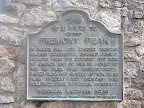
In March 1846, Jose Castro, Mexican military commander, ordered John C. Fremont from the country, and with Kit Carson and 60 men he moved to top of peak, built entrenchments, raised flag and awaited attack. Bear Flag Incident and Mexican War followed. State historical monument. HISTORICAL LANDMARK NO. 181 Department of Public Works - Division of Highways
lat:35.28052 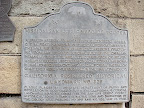
A Spanish Mission founded by Fray Junipero Serra, O.F.M., first President of the California Missions. This was the fifth in a chain of 21 missions stretching from San Diego to Sonoma, built by the Chumash Indians living in the area. Its combination of belfry and vestibule is unique among California missions. In 1846 John C. Fremont and his California battalion quartered here while engaged in the war with Mexico. CALIFORNIA REGISTERED HISTORICAL LANDMARK No. 325. Plaque placed by the State Department of Parks and Recreation in cooperation with the California Historical Landmarks Advisory Committee, the San Luis Obispo County Historical Society, and The Native Sons and Daughters of The Golden West, Parlors No. 290 and No.108, May 15, 1966.
lat:35.56508 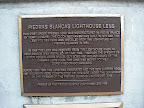
This first order Fresnel lens was manufactured in 1850 in France by Henry LaPaute. The clock mechanism was built in 1872 and the lens you see here was installed atop the lighthouse at Piedras Blancas in 1874. In 1949 the lens was removed from the lighthouse when an aero-beacon was installed. At that time, through the efforts of Byron Boisen, Eddie Shaug, Guy Bond and Roland Houtz of the Cambria Lions Club, the lens was moved to the Lions Pinedorado grounds. During 1990-1994 the lens was renovated and the new lantern room and walkways were constructed on this site under the leadership of The Friends of the Piedras Blancas Lighthouse Lens. Friends of the Piedras Lighthouse Lens 1998
lat:35.73827 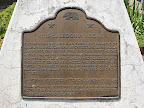
This imposing building is an excellent example of California's Mexican Era architecture. Using Indian labor, Petronilo Rios built the two-story adobe about 1846 as his residence and headquarters fro sheep and cattle operations. Named "Caledonia" in the 1860's, it served as a hotel and stagestop between Los Angeles and San Francisco until 1886. Restoration began in 1968 by The Friends of the Adobes. CALIFORNIA REGISTERED HISTORICAL LANDMARK NO. 936. Plaque placed by the State Department of Parks and Recreation in cooperation with Friends of the Adobes, November 22, 1981.
lat:38.29350 
|


|
Although the author has taken all reasonable care in preparing this guide, Mapicurious and the author make no warranty about the accuracy or completeness of its content and accept no responsibility for any loss, injury, or inconvenience arising from its use. |