| This map is found on Mapicurious.com | Download these points of interest directly into your favorite GPS or other geo software | |||
|
|||
| Use the zoom controls on the map to adjust the map's viewable area then print: | |||

| LOCATIONS highlighted on this map: |
|
lat:33.77285 
Established by Act of the General Assembly Oct. 13, 1885; site selected Oct. 20, 1886. Administration Building erected, 1887. First session, Oct. 7, 1888. In July, August, 1864, this site was occupied by one of a series of forts connected by rifle-pits which 12 mi. in extent, encircled Atlanta. During siege operations the city was defended by Gen. Hood's Army of Tennessee. Opposing this sector were the 4th and 20th Corps of the Federal Army of the Cumberland posted in the area between 10th and 14th Sts. The siege began July 22d and ended August 25. 060-99B Georgia Historical Marker 1994
lat:33.77285 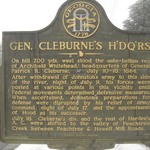
On hill 200 yds. west stood the ante-bellum res. of Archibald Whitehead, headquarters of General Patrick R. Cleburne, July 10-18, 1864. After withdrawal of Johnston's army to this side of the river, night of July 9, his forces were posted at various points in this vicinity until Federal movements determined defensive measures. When ascertained, Johnston's preparations for defense were disrupted by his relief of army command, night of July 17, and the appointment of Hood as his successor. July 18. Cleburne's div. and the rest of Hardee's A.C. were shifted to the valley of Peachtree Creek between Peachtree & Howell Mill Roads. 060-88 Georgia Historic Marker 1988
lat:33.668515 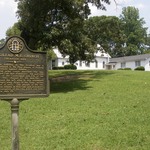
In 1864, the building at this location was a prominent landmark in the final phases of Federal military operations against Atlanta. Three Federal army corps marched this way enroute to Red Oak and Jonesboro; 4th and 14th of the Army of the Cumberland and 23d of the Army of the Ohio -- August 27, 28, and 29. These composed the left wing in this southward march; the right wing, Army of the Tenn., moved by roads west of here. The seizure of the two railroads below Atlanta at Red Oak and Jonesboro, forced the evacuation of the city which had been besieged since July 22. 060-167 Georgia Historic Marker 1990
lat:33.78585 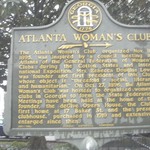
The Atlanta Woman's Club, organized Nov. 11, 1895, was inspired by a council meeting in Atlanta of the General Federation of Women's Clubs during the Cotton States and International Exposition. Mrs. Rebecca Douglas Lowe was founder and first president of this Club whose object is "threefold - social, literary and humanitarian." On Oct. 27, 1896, the Atlanta Woman's Club was hostess to organized women's clubs in Georgia to form the State Federation. Meetings have been held at the home of the founder, the deGive Opera House, the Club's first home at 17 Baker St. and the present clubhouse, purchased in 1919 and extensively enlarged since then. 060-149A Georgia Historical Commission 1956
lat:33.78780 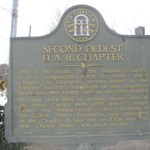
This is the home of the Atlanta Chapter, D.A.R., organized April 15, 1891; oldest Chapter in Georgia; second oldest in the National Society, Daughters of the American Revolution. Mrs. Henry Jackson was first Regent. Meetings were held in private homes and at the State Capitol, until 1895, when "Craigie House," the Massachusetts State building at the Cotton States Exposition was presented ti the Chapter. It was sold in 1909 and this new "Craigie House" was built in 1911. 060-4B Georgia Historical Commission 1953
lat:33.669447 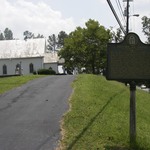
One of the first churches in Fulton County, Mt. Gilead was founded April 23, 1824 by Rev. John M. Smith (1789-1863) who is buried here. It was organized by Rev. William J. Parks. Many early settlers worshipped here and their descendants still live nearby. During the War Between the States the church was used by Confederates and Federals as a hospital. Confederate cavalry under Ross were here Aug. 15-16, 1864; McDowell's Confederate Scouts, Aug. 22, 1864. On Sunday, Aug. 28, 1864, a skirmish took place here as fragments of the Federal 2nd Div., Army of the Cumberland, moved toward Jonesboro. The church has been rebuilt several times. 060-111 Georgia Historical Commission 1956
lat:33.820997 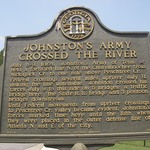
July 5-9, 1864. Johnston's Army of Tenn. held a fortified line N. of the Chattahoochee from Nickajack Cr. to one mile above Peachtree Cr. Federal crossings several miles upriver July 8, making the line untenable, Johnston crossed his forces July 9 to this side on 5 bridges: a traffic bridge here; the State R.R. bridge and 3 pontoon bridges downstream. Until Federal movements from upriver crossings to Peachtree Cr. valley became evident, Johnston's forces marked time here until the 18th when they were placed in the outer defense line of Atlanta N. and E. of the city. 060-85 Georgia Historic Marker 1985
lat:33.734105138651024 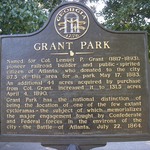
Named for Col. Lemuel P. Grant (1817-1893), pioneer railroad builder and public-spirited citizen of Atlanta, who donated to the city 87.5 of this area for a park May 17, 1883. An additional 44 acres acquired by purchase from Col. Grant, increased it to 131.5 acres April 4, 1890. Grant Park has the national distinction of being the location of one of the few extant cycloramas - the subject of which memorializes the major engagement fought by Confederate and Federal forces in the environs of the city - the Battle of Atlanta, July 22, 1864. 060-107 Georgia Historic Marker 1983
lat:33.819422 
lat:33.75645303402642 
lat:33.81305 |


|
Although the author has taken all reasonable care in preparing this guide, Mapicurious and the author make no warranty about the accuracy or completeness of its content and accept no responsibility for any loss, injury, or inconvenience arising from its use. |